
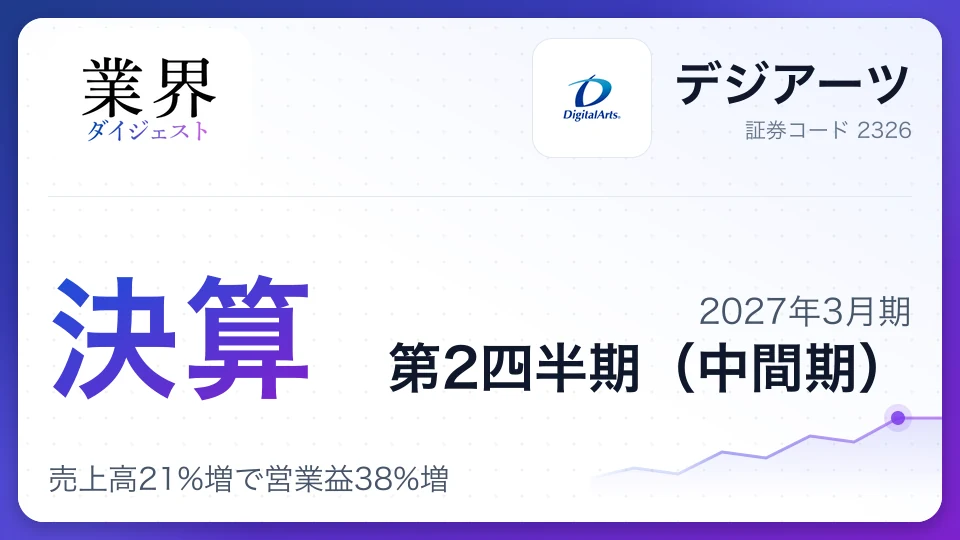
Digital Arts Q2 FY2027: Revenue rises 20.7%, operating profit jumps 37.8%

Digital Arts posted higher revenue and profit in FY2027 Q2, with sales up 20.7% year on year, operating profit up 37.8% and net income up 36.7%. Its operating margin rose to 46.2%, while an October disclosure of unauthorized access puts customer trust and remediation in focus.
The numbersSix months to date
First 6 months of the fiscal year, vs. a year earlier
| Actual | YoY | Full-year forecast | Progress | |
|---|---|---|---|---|
| Revenue | ¥6.0B | +20.7% | ¥12.0B | 50% |
| Operating profit | ¥2.8B | +37.8% | ¥5.4B | 52% |
| Net income | ¥1.9B | +36.7% | ¥3.8B | 51% |
| Operating margin | 46.2% | |||
Key takeaways
- 1Contract value rose 3.9% year on year to ¥6.889 billion, led by growth in corporate and government business.
- 2Public-sector sales increased 37.3% year on year as revenue recognition progressed for second-phase GIGA School Program projects.
- 3Corporate contract value climbed 13.2% year on year, with m-FILTER and new product z-FILTER contributing.
- 4The interim dividend rose to ¥50 from ¥45 a year earlier, and the annual dividend forecast is ¥100.
- 5Digital Arts disclosed unauthorized access to cloud-service operating environments and other systems in October, making prevention and rebuilding trust priorities.
Key results
Digital Arts reported higher revenue and profit for the six months ended September 2026. Revenue rose 20.7% year on year, operating profit increased 37.8%, and net income attributable to owners of the parent climbed 36.7%. The operating margin widened to 46.2% from 40.5% a year earlier, turning sales growth into a much sharper increase in profit.
- Revenue recognition progresses: Revenue was recognized on cloud-service contracts won in previous years, including those tied to the second phase of the GIGA School Program. Revenue from cloud contracts is recognized over the service period.
- Growth in corporate and government markets: Sales of products to businesses expanded, while projects for ministries and local governments also increased. Contract value rose 3.9% year on year, a more modest gain than revenue.
- Margin improvement: Costs such as communications expenses increased as cloud-service users grew, but selling, general and administrative expenses were below the year-earlier level as costs related to the previous period's 30th anniversary eased and hiring expenses were contained.
Revenue growth reflected not only contracts won in the current period but also large contracts secured in prior years and recognized over time, creating a lag between contract value and sales. Higher sales boosted operating profit, but sustained growth will depend on continued additions to new contracts. The company maintained its full-year forecast despite describing the interim results as progressing steadily.
Performance by market
Security is the company's only reported business segment, but among its sales markets, the public sector recorded the strongest growth. The figures below are sales by market; operating profit is not disclosed by market.
Public sector sales rose 37.3% year on year. Revenue was recognized from contracts signed in previous years for the second phase of the GIGA School Program, while projects for government ministries and the third round of local-government security upgrades also advanced. Public-sector contract value, however, fell 0.6%, reflecting a concentration of orders in the year-earlier period.
Corporate market sales increased 7.1% year on year. m-FILTER captured demand for email security, and corporate contract value grew 13.2%. The company also advanced z-FILTER opportunities and expanded its sales network, including the launch of the NEC Cyber Secure Package with the NEC Group.
Consumer market sales declined 8.9% year on year. Efforts to promote i-Filter 10 were not enough to offset lower demand through existing sales channels. The next stage of growth will depend on developing new orders from ministries, local governments and businesses without becoming overly reliant on large public-sector contracts.
- Public sector+37.3%
- Corporate+7.1%
- Consumer-8.9%
Full-year outlook
Digital Arts left its forecast for FY2027 unchanged. Interim progress stood at 50.2% of the full-year revenue forecast, 51.6% for operating profit and 51.0% for net income, all above halfway.
| Item (million yen) | Previous forecast | Current forecast | Interim results | Progress |
|---|---|---|---|---|
| Revenue | 12,000 | 12,000 | 6,024 | 50.2% |
| Operating profit | 5,400 | 5,400 | 2,785 | 51.6% |
| Ordinary profit | 5,505 | 5,505 | 2,838 | 51.6% |
| Net income | 3,770 | 3,770 | 1,924 | 51.0% |
The company said interim results were progressing steadily but made no changes to the forecast it announced in May 2026. Progress against the targets was generally above halfway, although public-sector contract value was affected by the reversal of a concentration of GIGA School Program orders in the year-earlier period. The latest earnings release did not include full-year actual results for the previous fiscal year, so the table compares the previous and current forecasts with interim results.
Financial position and capital policy
Total assets at the end of the interim period rose 15.5% from the end of the previous fiscal year to ¥32.173 billion, mainly reflecting an increase in cash and deposits. Cash flow from operating activities climbed to ¥6.109 billion from ¥3.271 billion a year earlier, adding to the company's cash reserves.
| Item | FY2027 interim-end actual | Comparison |
|---|---|---|
| Total assets | ¥32.173 billion | Up 15.5% from previous fiscal year-end |
| Equity ratio | 60.1% | 66.1% at previous fiscal year-end |
| Operating cash flow | ¥6.109 billion | ¥3.271 billion a year earlier |
| Investing cash flow | Negative ¥651 million | Negative ¥478 million a year earlier |
| Financing cash flow | Negative ¥1.050 billion | Negative ¥1.111 billion a year earlier |
| Annual dividend forecast | ¥100 | Previous-year actual: ¥95 |
Liabilities increased by ¥3.420 billion from the previous fiscal year-end, mainly because of higher advances received for services to be provided. The equity ratio declined, but cash and deposits increased to ¥27.488 billion from ¥23.083 billion at the previous fiscal year-end. The interim dividend rose to ¥50 from ¥45 a year earlier, and the annual dividend forecast was set at ¥100, ¥5 above the previous-year actual. The company also spent ¥665 million on share buybacks, combining investment for growth with shareholder returns.
Risks and challenges
Despite the earnings growth, Digital Arts' response to unauthorized access disclosed on Oct. 21, 2026, is a key management issue following the results. The company has explained its investigation findings and the impact on its products, but the effectiveness of its prevention measures and its ability to maintain customer confidence remain in focus.
- Unauthorized access and rebuilding trust: Unauthorized access was confirmed in the cloud-service operating environment and internal systems. The company said the incident was caused by compromised credentials, not by exploiting a vulnerability in its products' security functions, and that it found no tampering with its whitelist database. Depending on customer responses and additional measures, however, the incident could affect costs or contract renewals.
- More sophisticated cyberattacks: Attack methods are diversifying, including logins using stolen credentials, vulnerabilities in VPN equipment, and intrusions through contractors or SaaS services. The company must both secure its own services and develop products to counter these threats.
- Order volatility in large projects: Revenue recognition for the second phase of the GIGA School Program is progressing, but contract value for the project fell in the interim period after orders had been concentrated in the year-earlier period. Shifts in the timing of large orders could create a gap between growth in contract value and revenue.
- Contraction in the consumer market: Demand through existing sales channels declined, leaving consumer contract value and revenue below the year-earlier levels. Without progress in reaching new user groups, growth could become more dependent on corporate and public-sector markets.
Strategy
In the final year of its medium-term management plan, Digital Arts is prioritizing growth in its security business, a larger share of the public market, and stronger sales and development capabilities to support high-touch sales. In response to changing attack methods and wider workplace use of generative AI, the company aims to cover communications, authentication and devices with its product lineup.
- Managing generative AI use: The company plans to strengthen visibility into generative AI use and address security risks associated with inputs and outputs, with i-FILTER and z-FILTER at the core.
- Expanding corporate sales channels: Digital Arts launched the NEC Cyber Secure Package with the NEC Group. In addition to growth in m-FILTER, opportunities and orders for the new z-FILTER product are advancing.
- Pursuing government opportunities: The company is using its lineup of ISMAP-registered cloud products to win security projects from ministries and local governments. A key question is whether it can build a new pillar in the public sector beyond GIGA School Program projects.
Because revenue from cloud-service products is recognized over the contract period, it takes time for new orders to show up in sales. Revenue recognition from contracts won in previous years supported interim results. Investors will be watching whether new products and corporate and government projects can become the next foundation for contract and revenue growth.
Share price around the earnings release
Close on earnings release (Oct 30, 2026)
¥5,440
Latest close (Oct 30, 2026)
¥5,440
Reference chart of daily closing prices, not real-time quotes (split-adjusted; weekly closes before the last year). Updated Oct 30, 2026.
Compare Digital Arts with its rivals
Pay, results and share price side by side- vs
 TechMatrix vs Digital ArtsTechMatrix has 6.6x the revenueDigital Arts margin 33.4pt higherTechMatrix pays ¥1.47M moreCompare
- vs
 Trend Micro vs Digital ArtsTrend Micro has 25.5x the revenueDigital Arts margin 23.3pt higherTrend Micro pays ¥2.01M moreCompare
- vs
 IIJ vs Digital ArtsIIJ has 31.9x the revenueDigital Arts margin 34.1pt higherIIJ pays ¥0.48M moreCompare
Tags#Digital Arts#earnings#financial results#cybersecurity#GIGA School Program#cloud security#unauthorized access#dividends
Was this article useful?
Anonymous, no sign-up neededComments
The results show growth with improving margins, but also put the company's ability to rebuild trust to the test. Revenue recognition for the second phase of the GIGA School Program, combined with growth in corporate and government markets, helped profit rise faster than sales.
Contract value, however, grew more slowly than revenue, and public-sector results showed the impact of timing in large orders. With its full-year forecast unchanged, the company's ability to add new contracts in the second half will be important.
Digital Arts says the incident did not affect the whitelist operation of its products, but unauthorized access to the operating environment of a security company warrants close attention. Investors will want to see specific prevention measures and ongoing efforts to maintain customer confidence.
Cite or share this article
Quoting is free, no permission needed — just credit the source
https://www.gyokaidigest.com/en/companies/digital-arts/report/2027-Q2
Related articles
Latest from Cybersecurity
Company
Digital Arts Inc.
TSE: 2326
This is the latest earnings analysis
Next earnings date
Rivals reporting soon
609 companies report in the next two weeks · see the scheduleLatest earnings coverage
- TRUSCOQ3 FY2026TRUSCO Q3 FY2026: Sales jump 12%, but profit growth trails

- NxeraQ3 FY2026Nxera Q3 FY2026: Returns to profit as partnership income grows

- Genki GlobalQ2 FY2027Genki Global Q2 FY2027: Revenue jumps 42%, profit falls

- transcosmosQ2 FY2027transcosmos Q2 FY2027: Revenue rises as earnings slide on investment

- GenkyQ1 FY2027Genky Q1 FY2027: Sales rise, but profits fall as costs mount
