
FUSO Chemical Q2 FY2027: Raises outlook as AI chip demand lifts profit

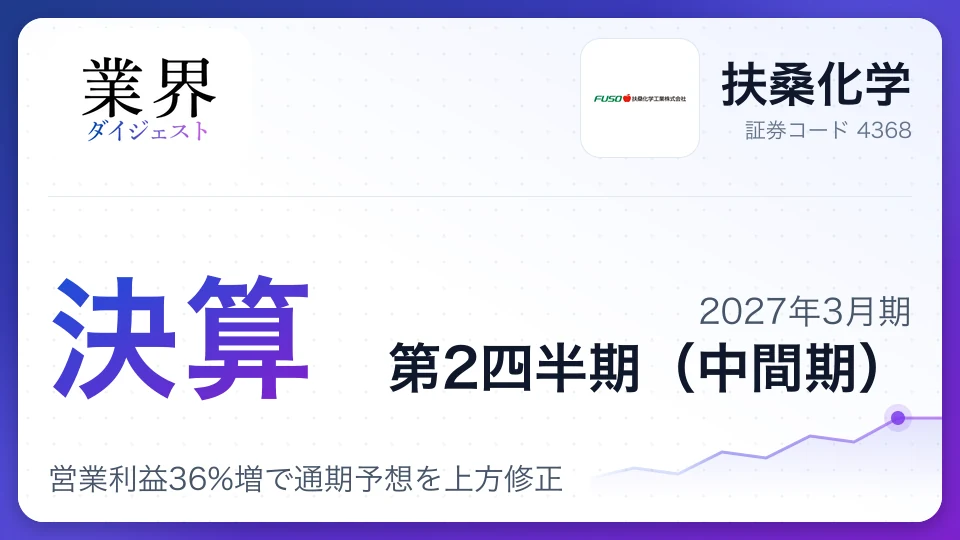
FUSO Chemical’s FY2027 first-half (April-September 2026) revenue rose 20.9% year on year, operating profit climbed 36.4% and net income increased 69.5%. AI-related semiconductor materials and food additives drove growth.
The numbersSix months to date
First 6 months of the fiscal year, vs. a year earlier
| Actual | YoY | Full-year forecast | Progress | |
|---|---|---|---|---|
| Revenue | ¥45.6B | +20.9% | ¥93.0B | 49% |
| Operating profit | ¥13.3B | +36.4% | ¥28.0B | 47% |
| Net income | ¥11.7B | +69.5% | ¥21.9B | 53% |
| Operating margin | 29.2% | |||
Key takeaways
- 1Electronic Materials sales rose 29.3% year on year, led by stronger sales of ultra-high-purity colloidal silica.
- 2Life Science operating profit increased 37.1%, supported by sales volumes and price revisions.
- 3The full-year operating profit forecast was raised by 3.7 billion yen to 28 billion yen.
- 4Subsidy income of 3.7 billion yen lifted interim net income, which rose 69.5% year on year.
- 5FUSO Chemical plans to invest 40 billion yen in colloidal silica manufacturing facilities at its Kyoto site, with completion scheduled for February 2029.
Results at a glance
FUSO Chemical recorded higher revenue, operating profit and net income in April-September 2026. Revenue rose 20.9% year on year, operating profit increased 36.4%, and interim net income attributable to owners of the parent climbed 69.5%. Electronic Materials led sales growth, while stronger core operations and subsidy income lifted net income.
- Semiconductor materials: Sales volume and unit prices for the company’s flagship ultra-high-purity colloidal silica rose, supported by demand for AI-related applications.
- Life Science products: Domestic and overseas sales volumes of organic acids and food-additive formulations increased. Price revisions and the weaker yen also contributed to revenue.
- Factors supporting profit: Higher sales volumes and prices, along with improved operating rates, boosted operating profit. Subsidy income of 3.7 billion yen also contributed to interim net income.
Geopolitical risks and concerns about trade friction continued to cloud the global outlook, while rising AI investment helped keep the semiconductor market firm. Operating profit grew faster than revenue, indicating that higher volumes, price revisions and improved factory utilization supported earnings. However, subsidy income is a non-recurring gain, so the sharp increase in net income should not be taken as a direct measure of sustained earnings growth.
Segment performance
Electronic Materials drove the company’s revenue growth, while Life Science also delivered higher revenue and profit. Increased sales volumes and price revisions supported both businesses.
Electronic Materials revenue rose 29.3% year on year, and operating profit increased 33.2%. Sales of the company’s flagship ultra-high-purity colloidal silica expanded, led by demand from AI-related semiconductor applications. Price revisions and the weaker yen also lifted revenue. Depreciation increased as new equipment came on stream at the Kashima site, but higher volumes and improved operating rates more than offset the additional cost.
Life Science revenue increased 11.5% year on year, while operating profit grew 37.1%. Domestic demand, including for food applications, remained firm. Overseas sales volumes rose for malic acid, gluconic acid and other organic acids, as well as food-additive formulations. Price revisions in competitive markets and yen-driven increases in exports and overseas subsidiaries’ sales also contributed.
Electronic Materials accelerated growth by capturing AI-related semiconductor demand, while Life Science expanded earnings through broader sales across products and regions. Depreciation from major equipment investment will continue to weigh on Electronic Materials, making it important to see whether higher production translates into profit growth. Life Science will need to navigate intense price competition and changing demand across markets.
| Segment | Revenue | Share | Operating profit | Operating margin |
|---|---|---|---|---|
| Life Science | ¥19.8B | 44% | ¥3.4B | 17.4% |
| Electronic Materials | ¥25.8B | 57% | ¥11.2B | 43.5% |
Full-year outlook
FUSO Chemical raised its forecast for the year ending March 2027 after both businesses outperformed plan in the first half. It expects demand for ultra-high-purity colloidal silica and sales expansion to continue in the second half, supported by growth in the semiconductor market.
| Item (million yen) | Previous forecast | Revised forecast | Previous-year result |
|---|---|---|---|
| Revenue | 85,800 | 93,000 | 76,926 |
| Operating profit | 24,300 | 28,000 | 18,850 |
| Ordinary profit | 24,500 | 28,100 | 19,573 |
| Net income attributable to owners of the parent | 19,200 | 21,900 | 14,311 |
The company increased its forecast from the previous outlook by 7.2 billion yen for revenue, 3.7 billion yen for operating profit and 2.7 billion yen for net income. The revised forecast represents year-on-year growth of 20.9% in revenue, 48.5% in operating profit and 53.0% in net income. At the interim stage, progress stood at about 49% of the revenue forecast and about 47% of the operating profit forecast. Continued demand in the second half and the utilization of production facilities will be key to meeting the targets.
Financial position and capital policy
Total assets and net assets increased from the previous fiscal year-end, reflecting accumulated earnings and progress on capital investment. The equity ratio declined from the year-end level but remained above 70%.
| Item | FY2027 interim | Previous year-end or year-earlier period | Change |
|---|---|---|---|
| Total assets (¥100 million) | 1,718.1 | 1,522.6 (previous year-end) | +195.5 |
| Equity ratio | 74.2% | 77.0% (previous year-end) | -2.8 percentage points |
| Cash flow from operating activities (¥100 million) | 179.7 | 116.0 (year-earlier period) | +63.7 |
| Cash flow from investing activities (¥100 million) | -74.1 | -68.3 (year-earlier period) | Higher outflow |
| Cash flow from financing activities (¥100 million) | -34.5 | -24.5 (year-earlier period) | Higher outflow |
On a post-split basis, the interim dividend was 14 yen per share, with a year-end forecast of 14 yen and a full-year forecast of 28 yen. The FY2026 annual dividend of 82 yen was paid before a three-for-one stock split; adjusted for the split, it would be about 27.3 yen, making the current-year forecast an effective increase. The company appears set to continue investing cash generated from operations in facilities while maintaining and increasing dividends. It has not announced a major share buyback.
Research and growth investment
FUSO Chemical is expanding production capacity for ultra-high-purity colloidal silica and strengthening its research and development base in anticipation of growing semiconductor demand. At its Kyoto site, it plans to invest a total of 40 billion yen in new manufacturing facilities, with completion scheduled for February 2029.
- Capacity expansion: The Kyoto site investment is planned to be funded internally. As of the end of the period, 807 million yen had been paid.
- Research and development capabilities: The company is expanding the functions of its Tokyo Research Institute and preparing to build an East Osaka Research Institute.
- Development priorities: Life Science is seeking new applications, while Electronic Materials is developing next-generation materials.
Depreciation rose as new equipment began operating at the Kashima site, but increased sales and improved operating rates more than offset the cost. The large Kyoto investment could support medium- to long-term supply capacity and growth if the company captures demand. It will also need to manage the investment burden before operations begin and respond to swings in demand.
Risks and challenges
The company said uncertainty about the global economy persists amid geopolitical risks, trade friction and rising prices. Investors will also need to watch demand shifts across businesses, price competition and the returns on major investments.
- Semiconductor market volatility: If AI-related demand falls short of expectations, sales of ultra-high-purity colloidal silica, utilization of new facilities and investment returns could all be affected.
- Geopolitical and trade conditions: A worsening of tensions in the Middle East or trade friction could disrupt raw-material procurement, logistics and overseas sales.
- Price competition and demand trends: Competition remains intense in Life Science, and weak domestic demand has also been noted in China. Slower price increases or sales-volume growth could pressure margins.
- Foreign-exchange movements: Yen depreciation boosted exports and sales at overseas subsidiaries, but a reversal in the currency trend could weaken that tailwind.
Share price around the earnings release
Close on earnings release (Oct 30, 2026)
¥2,889
Latest close (Oct 30, 2026)
¥2,889
Reference chart of daily closing prices, not real-time quotes (split-adjusted; weekly closes before the last year). Updated Oct 30, 2026.
Compare FUSO Chemical with its rivals
Pay, results and share price side by side- vs
 Kureha vs FUSO ChemicalKureha has 2.1x the revenueFUSO Chemical margin 36.0pt higherFUSO Chemical pays ¥0.16M moreCompare
- vs
 Toagosei vs FUSO ChemicalToagosei has 2.1x the revenueFUSO Chemical margin 15.8pt higherFUSO Chemical pays ¥0.18M moreCompare
- vs
 Nissan Chemical vs FUSO ChemicalNissan Chemical has 3.6x the revenueFUSO Chemical margin 1.8pt higherNissan Chemical pays ¥1.13M moreCompare
The Chemical industry now
60 companiesFUSO Chemical is one of 60 Chemical companies we cover, #52 by revenue. Here is how the industry’s shares and company plans look:
- Industry shares, 1 year
- +24.8%All industries +14.9%
- Op. profit plan, this FY
- +24.1%All industries +13.0%
- Forecasts raised
- 19cut 0
- Industry op. margin
- 8.8%
- FUSO Chemical+69.3%
- Chemical (average)+24.8%
- All industries+14.9%
- Latest resultsYear to date through Q1, 36 companies combined: revenue +13.3%, operating profit +51.0% year over year. 27 are ahead of an even pace toward their full-year plan, 4 behind.
- Revisions19 raised and 0 cut this year's forecast. The biggest revision: Osaka Organic (operating profit +45.3%).





Tags#FUSO Chemical#earnings#semiconductor materials#electronic materials#colloidal silica#AI chip demand#earnings forecast#dividend
Was this article useful?
Anonymous, no sign-up neededComments
AI-related semiconductor demand was a key driver of growth in Electronic Materials, while price revisions and overseas sales helped Life Science increase profit. Both businesses posted earnings growth, pointing to a broad-based earnings base rather than reliance on a single growth driver.
However, subsidy income contributed to the increase in net income. Investors will want to see whether core earnings growth can continue without one-off gains, and whether the major Kyoto investment generates adequate returns once the new facilities are operating.
Cite or share this article
Quoting is free, no permission needed — just credit the source
https://www.gyokaidigest.com/en/companies/fuso-chemical/report/2027-Q2
Related articles
Latest from Specialty & Functional Chemicals
Specialty & Functional Chemicals



Company
FUSO CHEMICAL CO., LTD.
TSE: 4368
This is the latest earnings analysis
Next earnings date
Rivals reporting soon
609 companies report in the next two weeks · see the scheduleLatest earnings coverage
- TRUSCOQ3 FY2026TRUSCO Q3 FY2026: Sales jump 12%, but profit growth trails

- NxeraQ3 FY2026Nxera Q3 FY2026: Returns to profit as partnership income grows

- Genki GlobalQ2 FY2027Genki Global Q2 FY2027: Revenue jumps 42%, profit falls

- transcosmosQ2 FY2027transcosmos Q2 FY2027: Revenue rises as earnings slide on investment

- GenkyQ1 FY2027Genky Q1 FY2027: Sales rise, but profits fall as costs mount
