
Japan Lifeline Q2 FY2027: Record first-half sales, profit falls 17%

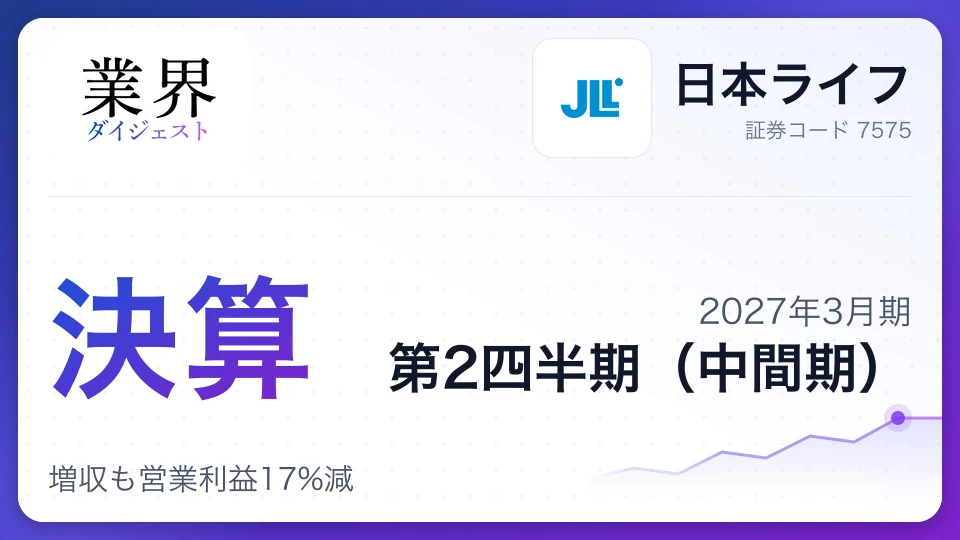
Japan Lifeline's FY2027 first-half revenue rose 7.1% to ¥31.35 billion, a record, while operating profit fell 17.4% to ¥5.47 billion and net income fell 7.2% to ¥4.43 billion. It kept its full-year outlook and expects annual dividends of ¥81, up ¥27.
The numbersSix months to date
First 6 months of the fiscal year, vs. a year earlier
| Actual | YoY | Full-year forecast | Progress | |
|---|---|---|---|---|
| Revenue | ¥31.4B | +7.1% | ¥63.2B | 50% |
| Operating profit | ¥5.5B | -17.4% | ¥10.7B | 51% |
| Net income | ¥4.4B | -7.2% | ¥8.0B | 55% |
| Operating margin | 17.4% | |||
Key takeaways
- 1Revenue rose 7.1% to ¥31.3 billion, setting a first-half record.
- 2Higher SG&A expenses, including research and development costs, contributed to a 17.4% drop in operating profit to ¥5.4 billion.
- 3Neurovascular sales rose 42.9%, while EP and ablation sales increased 10.3%.
- 4The full-year forecast is unchanged. Annual dividends, including a commemorative dividend, are expected to rise ¥27 from the previous year to ¥81.
- 5Japan Lifeline made U.S.-based Cross Vascular a subsidiary, advancing overseas expansion and broadening its product portfolio.
Earnings highlights
Japan Lifeline reported first-half revenue of ¥31.353 billion, up 7.1% from a year earlier, operating profit of ¥5.468 billion, down 17.4%, and net income attributable to owners of the parent of ¥4.430 billion, down 7.2%. Revenue was a record for the first half.
Gross profit increased just 2.6%, while selling, general and administrative expenses rose 14.8% to ¥12.55 billion. Key factors included:
- Research and development costs: Spending increased on new products such as the PFA system and on adapting Japan Lifeline's products for overseas markets.
- Personnel costs: Higher salary levels pushed expenses up.
- Acquisition-related costs: Outsourcing fees associated with acquisitions increased.
- Prior-year one-off factor: The company recorded a reversal of allowance for doubtful accounts in the year-earlier period, creating a drag on the year-on-year comparison.
The result was higher sales but lower profit as growth investment outpaced sales gains. Sales promotion for new products, revisions to official reimbursement prices and rising raw-material costs also contributed to a 2.5-percentage-point decline in the gross profit margin. Ordinary profit fell by a more modest 8.8%, supported by non-operating income including gains on investment securities and the reversal of the allowance for doubtful accounts.
Performance by product category
Japan Lifeline does not report operating segments in its earnings release. The following figures show sales by product category. EP and ablation, along with newer business areas, led growth.
EP/ablation sales were ¥16.222 billion, up 10.3% from a year earlier. Atrial fibrillation ablation procedures increased by about 10%, lifting sales of intracardiac defibrillation catheters and hemostasis devices for femoral veins. The radiofrequency wire for atrial septal puncture, launched in March 2026, also gained traction faster than expected.
Cardiovascular sales rose 4.1% to ¥6.177 billion. The Frozen Elephant Trunk product maintained a high market share, while sales of abdominal stent grafts grew following stronger sales initiatives.
- Neurovascular: ¥1.696 billion, up 42.9%. New model launches and higher sales volumes contributed to growth.
- Gastroenterology: ¥1.057 billion, up 34.4%. Sales of a new biliary tube stent were strong, while supply shortages of competitors' products provided a tailwind. Excluding discontinued businesses, sales rose 41.6%.
- Rhythm devices: ¥6.198 billion, down 7.0%. Market adoption of competitors' leadless pacemakers and new S-ICD products weighed on sales.
Both established core products and newer areas expanded, while rhythm devices, which the company considers a stable business, faced a changing competitive landscape. Japan Lifeline plans to use its combination of manufacturer and trading-company capabilities to bring products suited to healthcare providers' needs to market quickly.
Full-year outlook
Japan Lifeline left its consolidated earnings forecast for FY2027 unchanged. First-half revenue was tracking slightly ahead of the company's initial assumptions, but it expects to spend in the second half on research and development costs that were delayed in the first half.
| Metric (¥ millions) | Previous forecast | Current forecast | Previous-year actual (approx.) |
|---|---|---|---|
| Revenue | 63,200 | 63,200 | About 59,176 |
| Operating profit | 10,700 | 10,700 | About 12,603 |
| Net income attributable to owners of the parent | 8,000 | 8,000 | About 9,346 |
The approximate previous-year actual figures are reference values derived from the year-on-year changes in the company's forecast. The current forecast calls for revenue of ¥63.2 billion, up 6.8% from the previous year; operating profit of ¥10.7 billion, down 15.1%; and net income of ¥8 billion, down 14.4%. No forecast revisions were made.
The company said strong sales in EP and ablation, neurovascular and gastroenterology are offsetting weakness in rhythm devices. It expects sales to track its initial forecast in the second half, alongside higher spending on research and development. Whether sales growth can translate into profit growth remains a key focus.
Financial position and shareholder returns
Total assets stood at ¥80.005 billion at the end of the first half, down ¥205 million from the end of March 2026. The equity ratio rose to 82.9% from 82.1% at the previous fiscal year-end.
| Item | FY2027 first half | Comparison with year-earlier period or previous year-end |
|---|---|---|
| Total assets | ¥80.005 billion | Down ¥205 million from previous year-end |
| Net assets | ¥66.414 billion | Up ¥516 million from previous year-end |
| Equity ratio | 82.9% | Up 0.8 percentage points from previous year-end |
| Operating cash flow | ¥3.274 billion | Inflow of ¥3.495 billion in year-earlier period |
| Investing cash flow | Outflow of ¥242 million | Outflow of ¥1.023 billion in year-earlier period |
| Financing cash flow | Outflow of ¥3.826 billion | Outflow of ¥3.880 billion in year-earlier period |
Cash and cash equivalents fell ¥782 million from the start of the period to ¥11.711 billion. Operating cash flow was below the year-earlier level because of increases in trade receivables and inventories, as well as corporate tax payments. Investing cash outflows narrowed, in part because of the recovery of long-term loans.
Japan Lifeline paid a ¥25 commemorative interim dividend and forecasts a regular year-end dividend of ¥56. The full-year dividend forecast is ¥81, up ¥27 from ¥54 in the previous year. The company disclosed no share buyback. Its high equity ratio gives it room to pursue growth investment alongside shareholder returns.
Strategic developments
As a foothold for its U.S. business, Japan Lifeline established wholly owned subsidiary JLL Med USA Inc. and, on Oct. 1, 2026, made U.S.-based Cross Vascular Inc. a wholly owned indirect subsidiary. The acquisition was approved on Sept. 29, and the share purchase was completed after the end of the first-half reporting period.
The company's medium-term plan prioritizes the continued launch of competitive products, expansion into new fields, overseas sales growth, promotion of OEM manufacturing and management focused on capital efficiency. The acquisition is part of its effort to reduce reliance on the domestic market through globalization and build a pipeline of new products.
Japan Lifeline also plans to pursue research and development related to PFA, as well as opportunities in stent grafts and transcatheter aortic valve implantation (TAVI). Key indicators of longer-term growth will include how much the acquired business contributes to sales and profit, and whether the company can adapt products for overseas markets and strengthen its quality systems as planned.
Risks and challenges
An aging population and the shift toward minimally invasive treatment support market growth, but labor shortages at medical institutions, the official reimbursement system and product competition pose challenges to turning that growth into profit.
- Rising costs: A weaker yen and inflation could increase raw-material, logistics and personnel costs. Because official reimbursement prices limit the scope to pass on costs, margins could come under pressure.
- Product competition: Wider adoption of competing products such as leadless pacemakers and S-ICDs could further weaken rhythm-device sales.
- Research and development burden: Investment in areas such as PFA is increasing. If new product launches or market adoption are delayed, expenses could continue to run ahead of revenue.
- Overseas expansion and post-acquisition integration: Growing the U.S. business will require adapting products to local needs and establishing quality standards. If integration or commercialization of the acquired business falls behind plan, the expected growth benefits could be delayed.
- Pressure on healthcare capacity: Physician work-style reforms and staff shortages could affect procedure volumes and product adoption at medical facilities.
The company said it secured raw materials early and sees no particular impact on product supply from the situation in the Middle East at present. It will continue to monitor changes in procurement costs and supply conditions.
Share price around the earnings release
Close on earnings release (Oct 30, 2026)
¥1,590
Latest close (Oct 30, 2026)
¥1,590
Reference chart of daily closing prices, not real-time quotes (split-adjusted; weekly closes before the last year). Updated Oct 30, 2026.
Compare Japan Lifeline with its rivals
Pay, results and share price side by side- vs
 Nipro vs Japan LifelineNipro has 11.2x the revenueJapan Lifeline margin 15.6pt higherJapan Lifeline pays ¥2.74M moreCompare
- vs
 HOYA vs Japan LifelineHOYA has 16.0x the revenueHOYA margin 13.3pt higherJapan Lifeline pays ¥0.32M moreCompare
- vs
 Olympus vs Japan LifelineOlympus has 17.1x the revenueJapan Lifeline margin 11.7pt higherOlympus pays ¥0.90M moreCompare
The Medical Equipment industry now
10 companiesJapan Lifeline is one of 10 Medical Equipment companies we cover, #8 by revenue. Here is how the industry’s shares and company plans look:
- Industry shares, 1 year
- +6.5%All industries +14.9%
- Op. profit plan, this FY
- +32.8%All industries +13.0%
- Forecasts raised
- 2cut 1
- Industry op. margin
- 11.4%
- Japan Lifeline+8.6%
- Medical Equipment (average)+6.5%
- All industries+14.9%
- Latest resultsYear to date through Q1, 6 companies combined: revenue +14.2%, operating profit +60.7% year over year. 2 are ahead of an even pace toward their full-year plan, 3 behind.
- Revisions2 raised and 1 cut this year's forecast. The biggest revision: Terumo (operating profit +14.7%).



Tags#Japan Lifeline earnings#FY2027 Q2 results#Medical devices#EP and ablation#Research and development#Dividend forecast#U.S. acquisition#Neurovascular sales
Was this article useful?
Anonymous, no sign-up neededComments
Record first-half revenue alongside lower operating profit points to an increase in growth investment. EP and ablation continued to expand, while neurovascular and gastroenterology also posted gains, broadening the company's product growth base.
A recovery in profits, however, depends on research and development spending generating future sales. With more costs expected in the second half, investors will want to watch not only whether Japan Lifeline meets its full-year forecast, but also whether new products such as PFA and the U.S. acquisition can drive sustained profit growth.
Cite or share this article
Quoting is free, no permission needed — just credit the source
https://www.gyokaidigest.com/en/companies/japan-lifeline/report/2027-Q2
Related articles
More on Japan Lifeline
Latest from Precision & Medical Equipment
- Earnings Forecast RevisionTerumoOct 8, 2026Terumo: Book $97.5B Loss on CSL Deal Cut, Slashes Profit Outlook by Nearly 40 Percent
- EarningsOlympusQ1 FY2027Olympus Q1 FY2027: Operating profit surges 74% on endoscope demand
- EarningsHOYAQ2 FY2027HOYA Q2 FY2027: Operating profit jumps 31.6% as revenue rises
- FDA Import AlertOlympusOct 21, 2026Olympus: FDA alert restricts U.S. imports, forecast unchanged
- Subsidiary Share TransferHOYAOct 9, 2026HOYA: Sells US Vitreous Surgery Unit to Bausch + Lomb to Refocus Strategy
Precision & Medical Equipment
Company
Japan Lifeline Co., Ltd.
TSE: 7575
This is the latest earnings analysis
Next earnings date
Rivals reporting soon
609 companies report in the next two weeks · see the scheduleLatest earnings coverage
- TRUSCOQ3 FY2026TRUSCO Q3 FY2026: Sales jump 12%, but profit growth trails

- NxeraQ3 FY2026Nxera Q3 FY2026: Returns to profit as partnership income grows

- Genki GlobalQ2 FY2027Genki Global Q2 FY2027: Revenue jumps 42%, profit falls

- transcosmosQ2 FY2027transcosmos Q2 FY2027: Revenue rises as earnings slide on investment

- GenkyQ1 FY2027Genky Q1 FY2027: Sales rise, but profits fall as costs mount
