
Orico Q2 FY2027: Higher funding costs drive 43.7% net profit drop
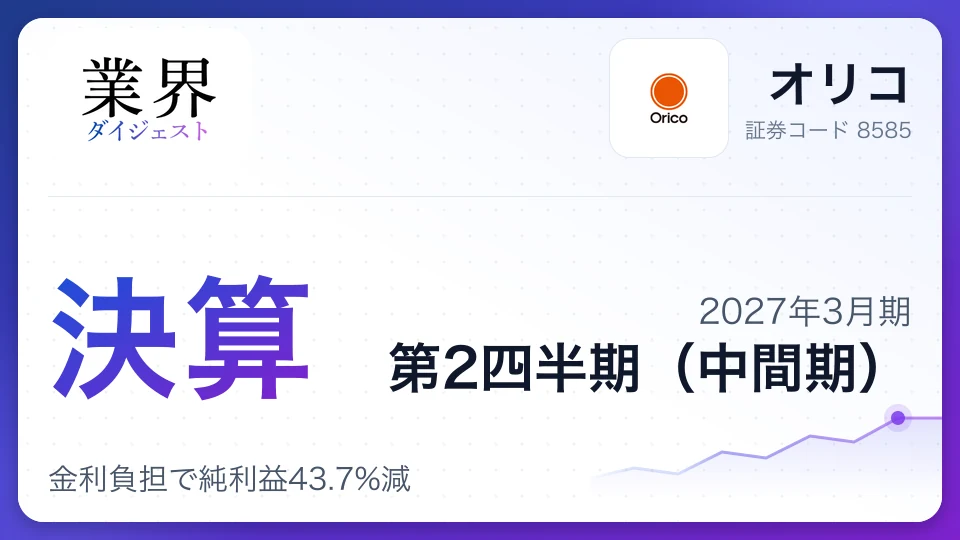
Orico's FY2027 first-half revenue rose 0.1% to ¥124.9 billion, while operating profit fell 24.2% to ¥5.4 billion and net income slid 43.7% to ¥3.5 billion. It kept its full-year outlook and ¥40 annual dividend.
The numbersSix months to date
First 6 months of the fiscal year, vs. a year earlier
| Actual | YoY | Full-year forecast | Progress | |
|---|---|---|---|---|
| Revenue | ¥125.0B | +0.1% | ¥260.0B | 48% |
| Operating profit | ¥5.5B | -24.2% | ¥15.0B | 36% |
| Net income | ¥3.5B | -43.7% | ¥13.0B | 27% |
| Operating margin | 4.4% | |||
Key takeaways
- 1Rent guarantees and accounts receivable payment guarantees posted higher transaction volumes year on year, with expanded partnerships also contributing.
- 2Higher market interest rates increased operating expenses by ¥7.2 billion from a year earlier, weighing on operating profit.
- 3Overseas transaction volumes declined as Orico tightened credit standards, while lower loan-loss expenses helped improve ordinary profit.
- 4Orico maintained its full-year operating revenue forecast of ¥260 billion and net income forecast of ¥13 billion, with an annual dividend of ¥40 planned.
- 5Total assets fell ¥6.1 billion from fiscal year-end to ¥2.8383 trillion, and the equity ratio declined to 8.7%.
Earnings at a glance
Orico's first-half operating revenue edged up 0.1% year on year to ¥124.9 billion, while operating profit fell 24.2% to ¥5.4 billion and net income attributable to owners of the parent declined 43.7% to ¥3.5 billion. Ordinary profit was down 24.2% to ¥5.4 billion. Revenue was nearly flat, but profits fell sharply, with the impact of higher interest rates on costs in focus.
| Operating profit bridge (¥100 million) | Amount |
|---|---|
| Year-earlier period | 72.03 |
| Increase in operating expenses | -72.00 |
| Other changes | 54.53 |
| First half | 54.56 |
Operating expenses increased ¥7.2 billion from a year earlier, mainly because higher market interest rates lifted financial costs. Revenue gains were not enough to absorb the increase, weighing on profit. Other changes are the difference calculated from the year-on-year change in operating profit and the disclosed increase in expenses.
The company said revenue grew in card loans and bank guarantees, while income from property sales also increased. Those gains were offset by lower revenue from overseas operations and other factors, leaving overall operating revenue little changed. The larger decline in first-half net income than in operating profit also highlights the importance of how much of the interest burden Orico can absorb in the second half to meet its full-year targets.
Business-line performance
Domestic payment and guarantee services and card loans showed growth, while transaction volumes at overseas operations declined as Orico tightened credit standards. In the second year of its medium-term management plan, the company aims to expand growth areas and advance business restructuring.
- Payment and guarantee business: Demand for rent guarantees remained firm amid growth in single-person households and rising home prices, with stronger sales efforts in the Tokyo metropolitan area also contributing. Volumes rose at existing accounts in accounts receivable payment guarantees, and Orico added new partners by deepening its collaboration with Mizuho Bank.
- Overseas business: Orico prioritized building a portfolio of quality receivables and tightened credit standards, resulting in lower transaction volumes at its three overseas subsidiaries than a year earlier. However, expenses related to loan losses declined, supported by measures including stronger collection systems, and ordinary profit improved.
- Card loan business: Use by major partners was strong and transaction volume increased, but loan balances were below the year-earlier level, in part because of a decline in new business.
- Individual installment credit business: Auto loan volume increased, while shopping credit declined as the company pursued measures that prioritized profitability.
- Bank guarantee business: Orico expanded financial services tailored to local needs. Term-loan volume increased, and guarantee balances rose from the end of the previous fiscal year.
In Japan, expanded partnerships and greater use by existing merchants are supporting growth. Overseas, Orico is prioritizing credit quality over volume, accepting a short-term revenue decline while seeking to contain credit costs.
Financial position and capital policy
Total assets fell from the end of the previous fiscal year, and the equity ratio edged down. Orico maintained its annual dividend forecast at ¥40, unchanged from the previous year, and made no revision in its latest earnings report. The report did not include cash flow statement figures, so operating, investing and financing cash flows cannot be compared.
| Item | End of first half of FY2027 | Comparison with previous period or year |
|---|---|---|
| Total assets | ¥2.8383 trillion | Down ¥6.1 billion from fiscal year-end |
| Net assets | ¥254.2 billion | Down ¥3 billion from fiscal year-end |
| Equity ratio | 8.7% | Down 0.1 percentage point from 8.8% at fiscal year-end |
| Annual dividend forecast | ¥40 | Same as the previous year's ¥40 |
The decline in total assets was mainly due to a decrease in cash and deposits, including as a result of repayments of interest-bearing debt. Net assets fell as retained earnings declined after dividend payments, and the equity ratio was also below its level at the end of the previous fiscal year. The report disclosed no share buyback, making the maintained annual dividend the only shareholder return measure confirmed this time.
Full-year outlook
Orico left its consolidated forecast for FY2027 unchanged. It expects operating revenue to rise 5.0% from the previous fiscal year, operating profit to increase 3.8% and net income attributable to owners of the parent to grow 0.9%. First-half results represented about 48% of the full-year revenue forecast, about 36% of the operating profit target and about 27% of the net income target, leaving ground to make up on profits in the second half.
| Item (¥ million) | Previous forecast | Current forecast | Previous-year result and comparison |
|---|---|---|---|
| Operating revenue | 260,000 | 260,000 | 250,465, up 5.0% year on year |
| Operating profit | 15,000 | 15,000 | Up 3.8% year on year |
| Net income attributable to owners of the parent | 13,000 | 13,000 | Up 0.9% year on year |
Orico made no changes to its forecast and maintained its annual dividend plan of ¥40. Operating revenue through the second quarter was broadly on plan, but profit progress was relatively slow. The key will be whether revenue growth and cost controls in the second half can offset the higher costs associated with rising interest rates.
Risks and challenges
Orico said it needs to watch rising interest rates and uncertainty surrounding economic conditions and policy in Japan and overseas. In businesses that involve extending credit, changes in customers' ability to repay and in loan-loss expenses can directly affect earnings.
- Rising interest rates: Higher market rates push up financial costs. If increases are not reflected promptly in lending rates or guarantee income, profit margins may come under pressure.
- Economic downturn: If higher prices weigh on consumer spending or corporate activity, card use and demand for loans could weaken, with potential effects on guarantee and installment credit businesses as well.
- Credit risk: Tighter underwriting reduced transaction volumes overseas. If Orico cannot maintain the quality of its receivables, loan-loss expenses could rise and erode profits.
- Geopolitical and policy uncertainty: The company is monitoring the impact on national economies of the Middle East situation, economic policies in Japan and overseas, and changes in financial markets.
Overseas, Orico tightened credit standards and restrained transaction volumes while reducing loan-loss expenses. Balancing growth with credit cost management, and passing higher interest costs through to business revenue, remain key challenges.
Strategic priorities
Orico's five-year medium-term management plan sets its ultimate goal as establishing a financial model unique to the company. FY2027 is the plan's second year, and Orico aims to accelerate growth by transforming business processes with AI and restructuring its operations.
- Consumer business: Orico plans to expand digital installment payments and personal auto leasing, which it identifies as growth areas, while deepening structural reforms centered on its individual installment credit business.
- Corporate business: The company aims to expand its customer base and deepen relationships by growing bank guarantees and accounts receivable payment guarantees. It also plans to broaden its corporate solutions.
- Operational transformation: Orico will review business processes, including through the use of AI, to strengthen a competitive operating base.
During the first half, Orico expanded partnerships in domestic guarantee-related services, while new business declined in card loans. Progress will depend not only on growing transaction volumes but also on converting growth into earnings while managing interest costs and credit expenses.
Share price around the earnings release
Close on earnings release (Oct 30, 2026)
¥767
Latest close (Oct 30, 2026)
¥767
Reference chart of daily closing prices, not real-time quotes (split-adjusted; weekly closes before the last year). Updated Oct 30, 2026.
Compare Orico with its rivals
Pay, results and share price side by side- vsOrico vs JACCSOrico has 1.3x the revenueJACCS margin 4.8pt higherOrico pays ¥0.15M moreCompare
- vs
 Acom vs OricoAcom has 1.4x the revenueAcom margin 23.9pt higherAcom pays ¥0.24M moreCompare
- vs
 Credit Saison vs OricoCredit Saison has 2.2x the revenueCredit Saison margin 12.8pt higherOrico pays ¥0.64M moreCompare
The Finance industry now
15 companiesOrico is one of 15 Finance companies we cover, #9 by revenue. Here is how the industry’s shares and company plans look:
- Industry shares, 1 year
- +5.6%All industries +14.9%
- Op. profit plan, this FY
- −3.6%All industries +13.0%
- Forecasts raised
- 1cut 0
- Industry op. margin
- 12.5%
- Orico−20.4%
- Finance (average)+5.6%
- All industries+14.9%
- Latest resultsYear to date through Q1, 3 companies combined: revenue +5.8%, operating profit +2.9% year over year. 4 are ahead of an even pace toward their full-year plan, 2 behind.
- Revisions1 raised and 0 cut this year's forecast. The biggest revision: Aiful (operating profit +9.5%).





Tags#Orico earnings#Japanese stocks#FY2027 results#consumer finance#interest rates#card loans#payment guarantees#credit risk#medium-term strategy
Was this article useful?
Anonymous, no sign-up neededComments
Orico's results show how exposed its earnings are to market interest rates: revenue was nearly flat, but profits fell sharply. Domestic guarantee services offer a growth opportunity through broader partnerships, yet Orico will need to expand revenue while managing the higher cost burden.
Overseas, the company is accepting lower transaction volumes as it tightens underwriting and reduces loan-loss expenses, prioritizing the quality of its receivables over short-term growth. With its full-year forecast unchanged, investors will be watching whether profit momentum improves in the second half, along with the trends in expenses and credit costs.
Cite or share this article
Quoting is free, no permission needed — just credit the source
https://www.gyokaidigest.com/en/companies/orient/report/2027-Q2
Related articles
Latest from Consumer Finance & Credit
Consumer Finance & Credit

Company
Orient Corporation
TSE: 8585
This is the latest earnings analysis
Next earnings date
Rivals reporting soon
609 companies report in the next two weeks · see the scheduleLatest earnings coverage
- TRUSCOQ3 FY2026TRUSCO Q3 FY2026: Sales jump 12%, but profit growth trails

- NxeraQ3 FY2026Nxera Q3 FY2026: Returns to profit as partnership income grows

- Genki GlobalQ2 FY2027Genki Global Q2 FY2027: Revenue jumps 42%, profit falls

- transcosmosQ2 FY2027transcosmos Q2 FY2027: Revenue rises as earnings slide on investment

- GenkyQ1 FY2027Genky Q1 FY2027: Sales rise, but profits fall as costs mount
